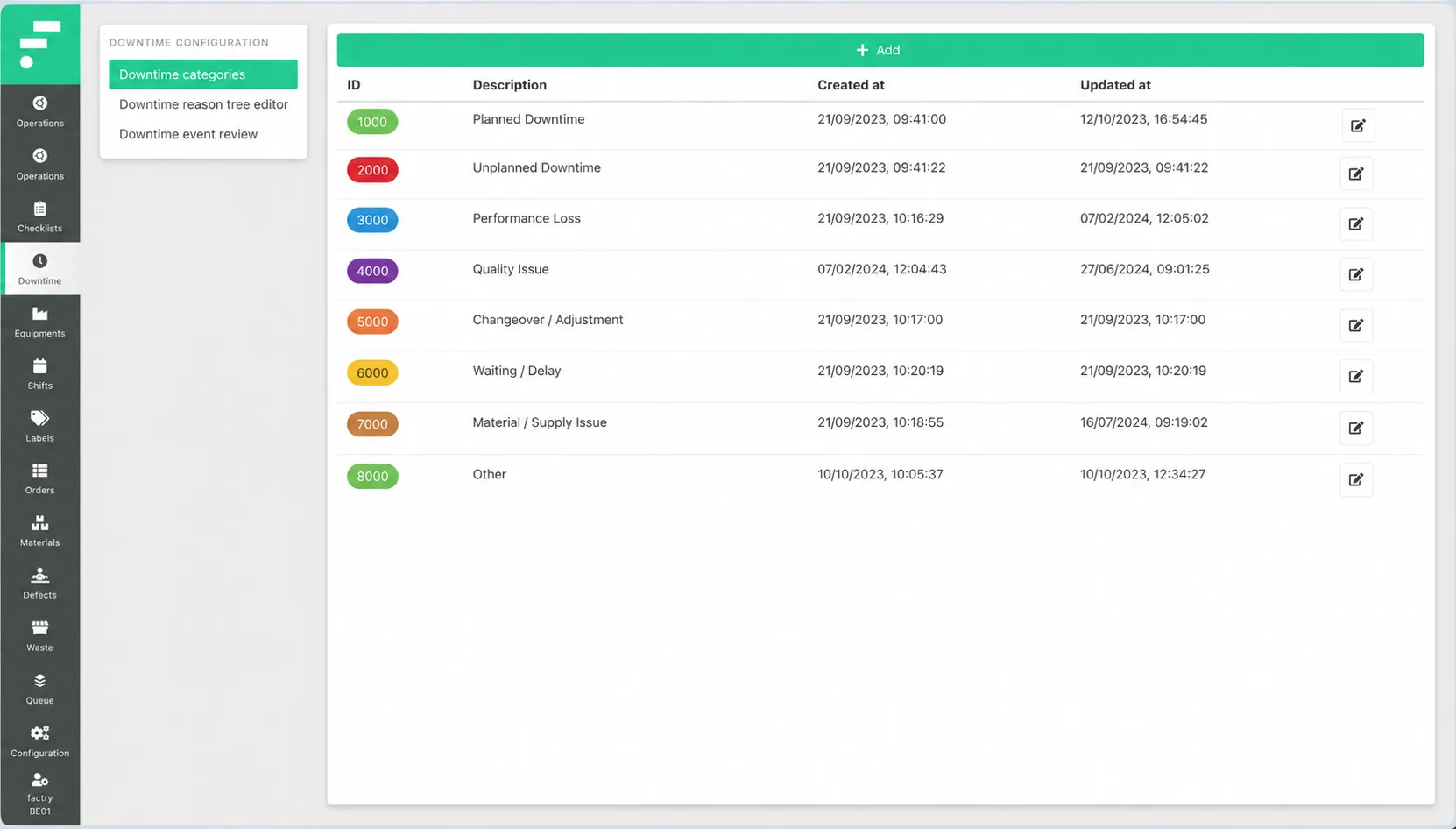
Downtime categories
What are downtime categories?
A downtime category is the top-level classification of a production stop. Every downtime event must belong to a category. Categories determine how a stop is counted in OEE calculations and how it is displayed across dashboards and reports.
In general, downtime categories typically fall into a few standard buckets used across most manufacturing operations:
Unplanned downtime — stops that weren't scheduled and disrupt production: equipment failure/breakdown, jam or blockage, power outage, missing operator, quality hold.
Planned downtime — stops scheduled in advance, often excluded from availability loss: changeover/setup between products, scheduled maintenance, shift breaks, planned cleaning (CIP/SIP), no production scheduled.
Performance loss (not a full stop, but related) — equipment running but underperforming: reduced speed, minor stops/microstops, startup/warm-up time.
Why does it matter?
OEE availability is calculated differently depending on whether a stop was planned, unplanned, or part of a change-over. Without categories, all stops look the same and your OEE figures are meaningless. Categories are the foundation that makes the distinction possible.
How does it fit in the system?
Categories sit at the top of the classification hierarchy. Every downtime reason belongs to exactly one category. Every state transition row maps to a category. When a downtime event is created, either automatically or manually, it inherits a category from the reason or transition that triggered it. That category then flows into OEE calculations and Grafana dashboards.
Example
A line stops unexpectedly for 6 minutes. The state transition fires and assigns the category Unplanned Downtime (2000). This stop is counted as unplanned downtime in the availability calculation. Later in the shift, the line stops for a scheduled cleaning. That stop maps to Planned downtime (1000) and is excluded from unplanned downtime figures. Same physical stop duration, different OEE impact, because of the category.