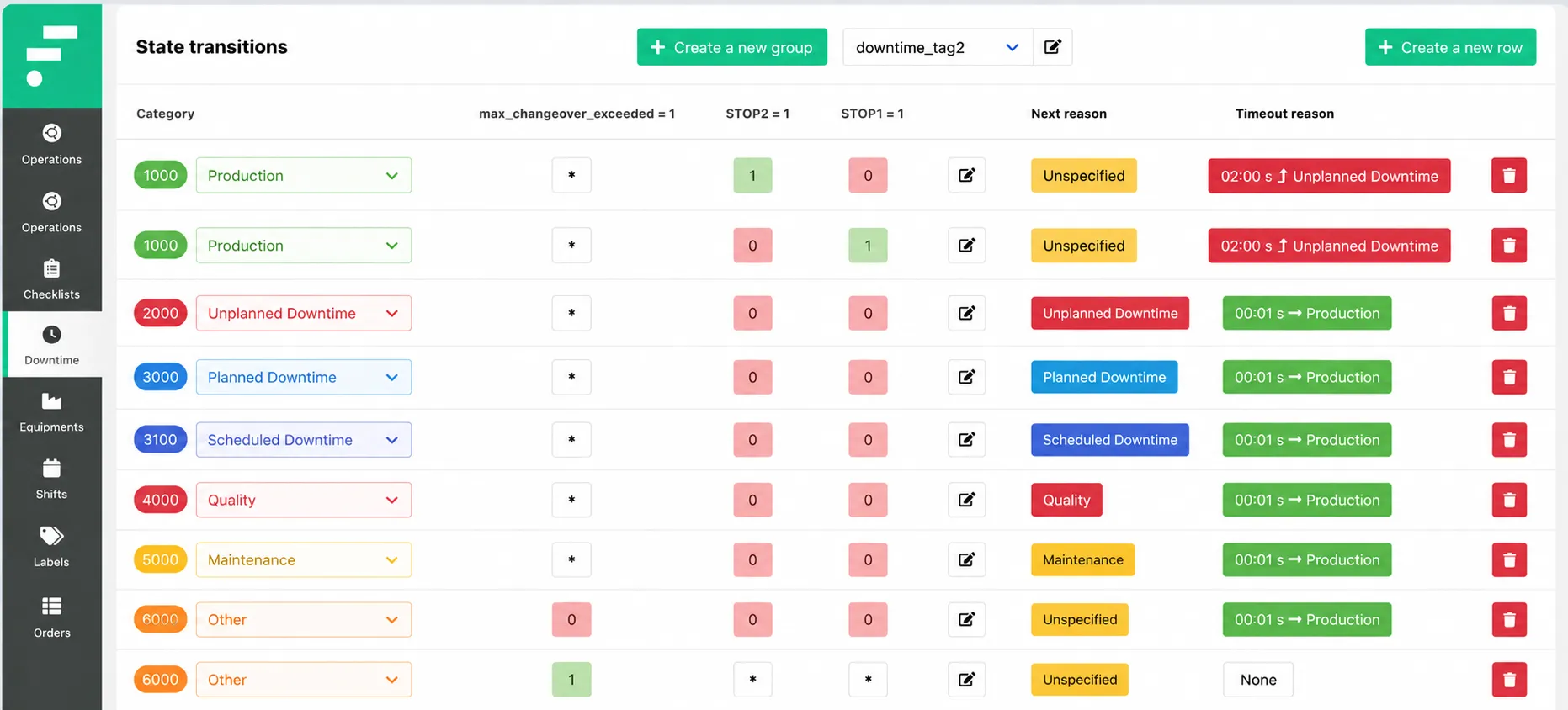
State transition groups
What is a state transition group?
A state transition group is a set of rules that translates raw signal values from Factry Historian into downtime states. It is the logic layer that determines, automatically, what category and initial reason to assign to a production stop based on the combination of signals available from the equipment.
Why does it matter?
PLC signals are low-level: a tag goes to 1, a speed drops below a threshold, an alarm bit flips. On their own they carry no production meaning. A state transition group maps those signals to meaningful states such as running, unplanned stop, or change-over. Without it, automatic downtime detection is not possible and operators must classify every event from scratch.
How does it fit in the system?
Each row in a state transition group defines one rule: a combination of signal values that maps to a category, a next reason, and an optional timeout reason. The group is evaluated continuously against incoming data from Factry Historian. When a signal combination matches a row, the corresponding downtime event is created or updated automatically. The group is assigned to one or more pieces of equipment in the Equipment Manager via the OEE tab. Different equipment types can have different groups, each reflecting the signals and states relevant to that equipment.
Example
A profiling line has two signals: STOP1 and STOP2. When STOP1 = 1 and STOP2 = 0, the line is in a microstop state and the reason Microstop is assigned automatically. When both signals are 0, the line is running and the category production running applies. Each combination is a single row in the state transition group assigned to that line.