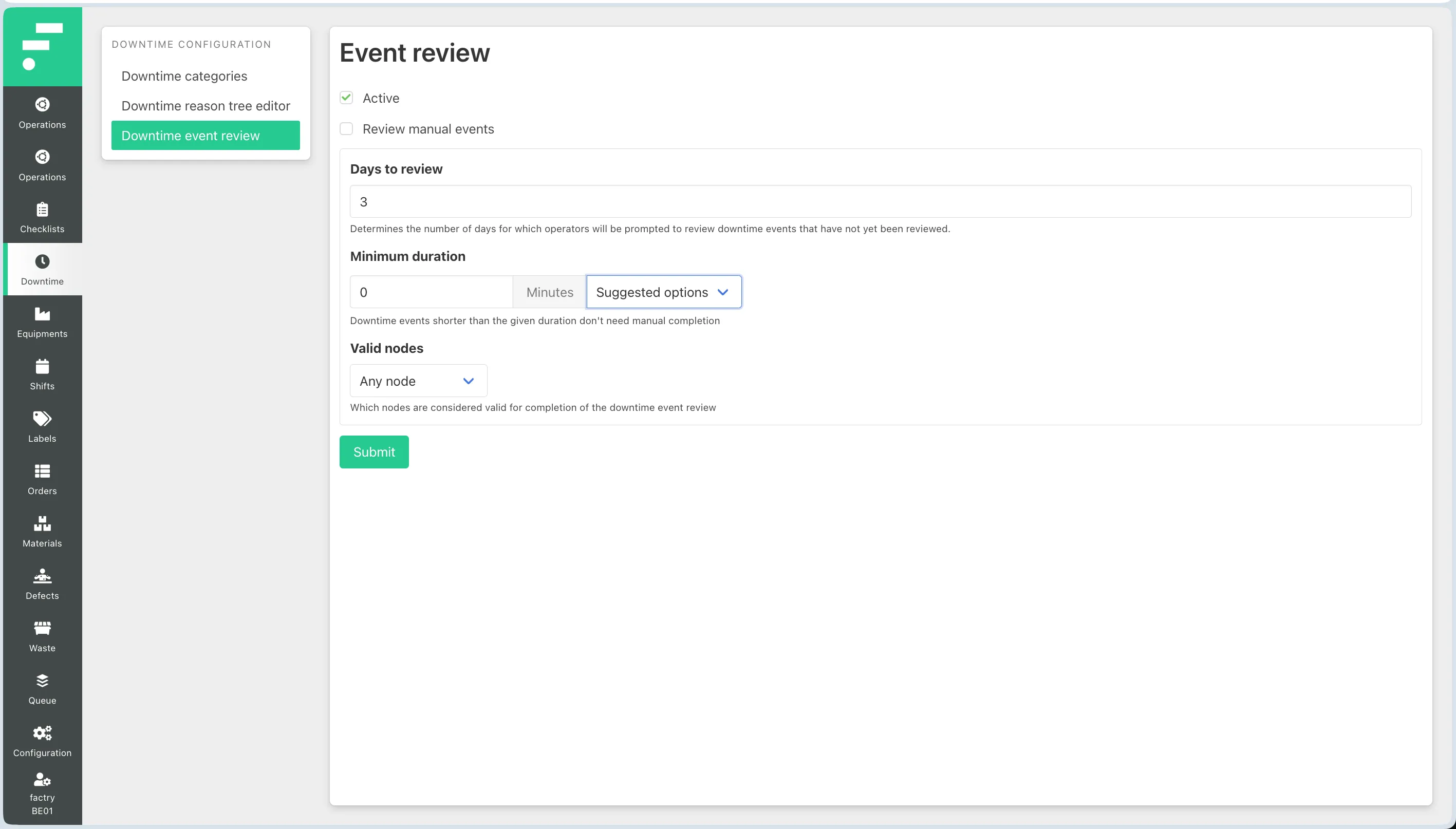
Downtime event review
What is downtime event review?
Downtime event review is the mechanism that ensures every downtime event above a certain duration threshold gets a reason assigned to it. It controls when and how operators are prompted to complete unclassified events, and what counts as a valid classification.
Why does it matter?
Automatic detection creates events, but it cannot always determine the true reason for a stop. Without a structured review process, events accumulate without reasons, and reporting becomes unstructured. Event review closes that gap by prompting operators within a defined window and enforcing the level of specificity you require.
How does it fit in the system?
Event review is a global configuration that applies across the Downtime Manager. It defines the review window (how many days back the system looks for unclassified events), the minimum duration threshold below which events are exempt from review, and whether operators must select a leaf node reason or can stop at a higher level in the tree. It works in combination with reason trees and categories to determine what a completed classification looks like.
Example
Event Review is configured with:
- Review window: 8 hours
- Minimum event duration: 5 minutes
- Reason selection: Leaf nodes only
At 09:00, a 3-minute microstop is detected. Because it is shorter than the 5-minute minimum duration, it is automatically excluded from the review process and requires no operator action.
At 10:30, a 12-minute unclassified stop occurs. Since it exceeds the minimum duration and is still within the 8-hour review window, it appears in the operator's Event Review queue. The operator must assign a leaf-level reason from the configured reason tree. Once a valid reason has been selected, the event is marked as reviewed and the task is completed.